
Website accessibility law UK: keyboard and screen reader use
At a glance
UK-12MediumEquality Act 2010, ss. 20, 29 and Sch. 2; EHRC Code of Practice: Services, public functions and associations (2026), paras. 5.45, 7.22 and 7.36
Peeky looks for accessibility barriers on public pages, such as missing alt text, unlabelled fields, weak contrast and keyboard traps.
Last checked against the source:
The rule
Section 29 of the Equality Act 2010 covers “a person (‘a service-provider’) concerned with the provision of a service to the public or a section of the public (for payment or not)”. Such a provider “must not discriminate against a person requiring the service by not providing the person with the service” (s. 29(1)), and must not discriminate in the terms on which it provides the service or by subjecting the person to any other detriment (s. 29(2)). Section 29(7) adds that “a duty to make reasonable adjustments applies to” a service-provider.
Section 20 sets out what the duty is. The first requirement applies “where a provision, criterion or practice of A’s puts a disabled person at a substantial disadvantage in relation to a relevant matter in comparison with persons who are not disabled”, and asks A “to take such steps as it is reasonable to have to take to avoid the disadvantage” (s. 20(3)). The third requirement asks for an auxiliary aid where a disabled person would otherwise be at that disadvantage (s. 20(5)). Where either relates to information, the reasonable steps “include steps for ensuring that in the circumstances concerned the information is provided in an accessible format” (s. 20(6)). The provider is not entitled to require the disabled person to pay any of its costs of complying (s. 20(7)). For services the applicable schedule is Schedule 2.
The Act does not use the words website, screen reader or WCAG. It works through the general duty, and the Code applies it to online services.
The EHRC’s statutory Code, presented to Parliament in 2026, says goods and services “provided remotely through mediums like websites or apps” are within the Act’s reach (para. 11.74). It also says the duty is anticipatory: providers “must proactively consider the barriers that disabled people could face and take action to address those barriers”, before an individual disabled person tries to use the service (para. 7.22). Its own example is a legal services firm whose website has “all its text embedded within graphics”: blind users cannot change the font size or use text-to-speech software, which “places those with a visual impairment at a particular disadvantage” and, the Code says, “will be indirect disability discrimination unless the provider can justify it” (para. 5.45).
What counts as reasonable “depends on all the circumstances of the case”. The Code lists the type of service, “the nature of the service provider, … its size and resources” and the effect of the disability on the individual (para. 7.36). Factors include whether the step would be effective, whether it is practicable, its cost and disruption, and the resources available (para. 7.37). Size is a factor in the judgment but not an exemption: “no service provider is exempt from duties under Part 3 because of size” (para. 1.22).
No fixed penalty is attached to a website that fails the duty. The consequence is a civil claim, covered below. Neither the Act nor the Code names WCAG or any other technical standard, so what is reasonable is argued case by case. PeekWell tests against WCAG 2.1 level AA because it is the common technical reference, not because the Act requires it. EU-10 explains the standard that sits behind the EU rule.
What PeekWell checks and how
UK-12 asks the same question as EU-10: are there barriers for keyboard and screen reader users on the public pages the scan visited? The answer comes from the pages as a visitor’s browser shows them.
The scan is automated. It tests your key public pages against WCAG 2.1 level AA and records each barrier by success criterion. It looks for missing alt text, form fields without labels, text with too little contrast, missing landmarks, keyboard traps and a missing page language. The report frames a finding as claim risk, because the Act attaches no fixed fine.
The scan has limits, and the report says so. It sees the public pages it visited, and the members area when you give it a sign-in. It doesn’t port-scan, try to get in where it isn’t allowed or run any security test. Automated tests find only part of what a person using a screen reader would run into, and some things they can only mark as uncertain. It can’t judge whether a step was reasonable for your business, which is the legal question. A Passed means the expected behaviour was observed on the pages scanned. It doesn’t say the site complies.
Why it matters for a company
The consequence in this jurisdiction is a claim, and it is brought by the person affected, not by a regulator checking a list. As of 7 October 2026 we could not confirm any court or regulator decision about a company website under the Act at the court’s or regulator’s own page, so this section rests on the statute and the Code, and names no company.
A person who believes they were discriminated against in the provision of services “may bring civil proceedings”, normally in the county court in England and Wales or the sheriff court in Scotland (paras. 14.6 and 14.7). Court action must start within six months minus one day of the alleged act, as the Code puts it (para. 14.13; s. 118), and the court can extend that where it is just and equitable (s. 118(1)(b); Code, citing s. 140AA). The county court can grant an injunction and award damages, and damages “may include compensation for injured feelings” (paras. 14.46 and 14.47). On damages the Code adds that a claimant should also try to show “some detriment as a result of the breach of duty” (para. 7.56).
Three consequences follow. An injunction is an order to change the site, so the remedy can cost more than the damages. The duty is anticipatory, so “we had no complaint” does not answer what the company had thought about in advance. And section 20(7) bars the company from passing the cost of an adjustment to the disabled person.
We found no UK regulator publication comparable to the Dutch ACM’s survey under the EU rule. The EU position is in EU-10, and the much heavier US litigation record is in US-06.
Smaller companies and larger companies
The Act has no size exemption. The Code says small providers “may have more informal practices, fewer written policies and be more constrained by financial resources”, and that size and resources are part of what is reasonable (paras. 1.22 and 7.36). A small company is not excused, but what it is expected to do is scaled to what it can do.
In a small company the site is usually a theme on a hosted platform with a few plugins. The barriers come from the template and the content: product photos without descriptions, a contact form whose fields have only placeholder text, grey text on a pale background, a menu the Tab key cannot reach. Template edits fix most of it.
In a larger company the same barriers arise from scale. Several teams and suppliers change the site, and a release can undo a fix. The resources factor in paragraph 7.37 cuts the other way: a larger business has more means, so more is reasonable to expect. The gap is usually process, with no accessibility tests in the release pipeline and no record of what was checked and when.
Enforcement cases
Published decisions about other companies, listed for context. Each links to the authority's own page. They say nothing about any particular website.

Larger companies
Royal Bank of Scotland Group plc (Allen)
The county court found that the bank had failed to make reasonable adjustments under the Disability Discrimination Act 1995, the predecessor of the Equality Act duty, because a young wheelchair user could not get into its main Sheffield branch. It ordered a platform lift to be installed, and the Court of Appeal dismissed the bank's appeal, saying reasonable steps were available that the bank had not taken.
Read the Court of Appeal of England and Wales publication about Royal Bank of Scotland Group plc (Allen)FirstGroup plc (Paulley)
Under sections 20 and 29 of the Equality Act 2010, the Supreme Court held that a bus company's policy of only asking other passengers to leave the wheelchair space did not go far enough, and that drivers should be trained to take further steps when a request is ignored. It did not restore the £5,500 damages awarded at first instance, because there was no finding on what a better policy would have achieved.
Read the UK Supreme Court publication about FirstGroup plc (Paulley)The Government Legal Service (Brookes)
The Employment Appeal Tribunal upheld findings that requiring an applicant with Asperger's syndrome to pass an online multiple-choice test, and refusing her request to give short written answers, was a failure to make reasonable adjustments under section 20 of the Equality Act 2010, as well as indirect discrimination. The case concerns recruitment, not a service to the public, but the duty is the same one.
Read the Employment Appeal Tribunal publication about The Government Legal Service (Brookes)Ryanair Ltd and Stansted Airport Ltd (Ross)
The county court found that making a disabled passenger pay for a wheelchair to get from check-in to the aircraft at Stansted was discrimination under the Disability Discrimination Act 1995, the predecessor of the Equality Act duty. The Court of Appeal dismissed Ryanair's appeal and held that the airport operator was also liable for half of the damages.
Read the Court of Appeal of England and Wales publication about Ryanair Ltd and Stansted Airport Ltd (Ross)AECOM Ltd (Mallon)
An employment tribunal found that AECOM failed to make reasonable adjustments under sections 20, 21 and 39(5) of the Equality Act 2010 by not letting an applicant with dyspraxia apply orally instead of through its online application form. The Employment Appeal Tribunal upheld the finding that AECOM should have telephoned him to ask about his difficulties with the form, but sent the case back for the tribunal to reconsider whether he was a genuine applicant.
Read the Employment Appeal Tribunal publication about AECOM Ltd (Mallon)Minister for the Cabinet Office (Rowley)
The High Court declared that the lack of British Sign Language interpretation for the broadcast of two government data briefings in September and October 2020 was a failure to make reasonable adjustments under sections 20, 21 and 29 of the Equality Act 2010, discriminating against a deaf claimant. It rejected the wider claim for an interpreter on the platform at later briefings, because in-screen interpretation and subtitles were already provided.
Read the High Court of England and Wales (Administrative Court) publication about Minister for the Cabinet Office (Rowley)Department for Work and Pensions
Four deaf people who needed a British Sign Language interpreter to use a DWP telephone service on home loans could not get one arranged, and only one managed it, after three months. The DWP signed a 12-month agreement with the EHRC to improve support for deaf customers using its phone services and its approach to reasonable adjustments for other disabled customers.
Read the Equality and Human Rights Commission (EHRC) publication about Department for Work and Pensionsbmibaby
Two blind customers alleged that the airline's booking website could not be used with a screen reader or without a mouse, so they had to book through a call centre, and that this fell short of the Equality Act duty. RNIB said it had given the airline an audit report and recommendations before proceedings began. No court decision on the claim has been published.
Read the County court claim brought by two customers with RNIB's support (reported by Disability News Service) publication about bmibaby
Smaller companies
Joydisc Ltd (Purves)
The manager of a restaurant refused to let a blind customer in with his guide dog. The sheriff found discrimination under the Disability Discrimination Act 1995, the predecessor of the Equality Act rules for service providers, and on appeal the Sheriff Principal raised the award, noting that no apology or explanation had ever been offered. The case is about refusing service, not about a website.
Read the Sheriff Principal of Lothian and Borders, Edinburgh Sheriff Court publication about Joydisc Ltd (Purves)
How to fix it
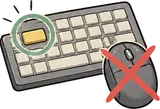
- Try your own site with the keyboard. Put the mouse away and press Tab through the home page, a product or service page and your contact or checkout form. Note where you cannot reach a control, cannot see where you are or cannot leave a pop-up. WCAG 2.1.2 asks that focus can always move away, and 2.4.7 that the focus indicator is visible.
- Give every picture and control a name. Meaningful images need a text alternative (WCAG 1.1.1), and form fields need a visible label tied to the field, not placeholder text alone.
- Check contrast. WCAG 1.4.3 asks for a ratio of at least 4.5:1 for normal text and 3:1 for large text. Browser developer tools show the ratio for any element.
- Set the page language. WCAG 3.1.1 asks that the language of each page can be determined by software.
- Offer a way to tell you about a barrier. Add a contact route on every page, and keep a record of what you changed in response. A written trail shows what the business considered in advance.
- Re-scan. Run a scan after each change. A finding should disappear once the barrier behind it is fixed. Then test with a screen reader yourself or with people who use one, because an automated scan won’t catch everything.
<label for="phone">Phone number</label>
<input id="phone" name="phone" type="tel" autocomplete="tel">
Whether the steps you take are reasonable for your business is a question for your legal adviser, and Peeky reports only what it sees.
Questions
Is website accessibility a legal requirement in the UK?
For a business that serves the public, yes, through the duty to make reasonable adjustments in the Equality Act 2010. The EHRC Code says services provided remotely through websites or apps are covered.
There is no separate statute for private sites that sets a technical standard. The rule has the wording.
Is WCAG a legal requirement in the UK?
Not by name. Neither the Equality Act nor the EHRC Code mentions WCAG.
A court asks whether you took the steps it was reasonable to take. WCAG is a common technical reference and testing tools report against it, which is why Peeky does too.
Does the European Accessibility Act apply in the UK?
It is EU law, so it does not govern a site that only serves visitors in the UK. It can reach a UK business that offers services to consumers in the EU.
The Directive defines a service provider as anyone who provides a service on the Union market or makes offers to consumers in the Union. EU-10 has the detail.
What are reasonable adjustments for a website?
They are the steps it is reasonable for your business to take so that disabled visitors are not at a substantial disadvantage. The EHRC Code says this depends on the service, the provider's size and resources, and how the disability affects the person.
For a developer it usually starts with keyboard use, text for images, labels on fields and readable contrast.
Can someone take a UK business to court over an inaccessible website?
Yes. A disabled person can bring a civil claim, normally in the county court in England and Wales or the sheriff court in Scotland.
The time limit is six months minus one day from the act, which a court can extend. The court can order an injunction and award damages, and damages can include compensation for injured feelings.
Filed with
The rule
Equality Act 2010, ss. 20 (duty to make adjustments), 29 (service providers) and Schedule 2
Read the rule (Equality Act 2010, ss. 20 (duty to make adjustments), 29 (service providers) and Schedule 2)A case
Royal Bank of Scotland Group plc (Allen)
Read the decision (Royal Bank of Scotland Group plc (Allen))Sources
The law
- Equality Act 2010, section 20, Duty to make adjustments (legislation.gov.uk)
- Equality Act 2010, section 29, Provision of services, etc. (legislation.gov.uk)
- Equality Act 2010, section 21, Failure to comply with duty (legislation.gov.uk)
- Equality Act 2010, Schedule 2, Services and public functions: reasonable adjustments (legislation.gov.uk)
- Equality Act 2010, section 118, Time limits (legislation.gov.uk)
- Equality Act 2010, section 119, Remedies (legislation.gov.uk)
- Public Sector Bodies (Websites and Mobile Applications) (No. 2) Accessibility Regulations 2018 (SI 2018/952), for public bodies only
- Directive (EU) 2019/882 (European Accessibility Act), Official Journal L 151, 7.6.2019, Art. 3(4)
Guidance
- EHRC, Statutory Code of Practice: Services, public functions and associations (Crown copyright 2026, presented to Parliament under section 14 of the Equality Act 2006)
- GOV.UK (Government Digital Service), Understanding accessibility requirements for public sector bodies
- GOV.UK Service Manual, Making your service accessible: an introduction
- Cabinet Office Disability Unit, Accessible communication formats (updated 17 June 2026)
- W3C, Web Content Accessibility Guidelines (WCAG) 2.1, Recommendation
- W3C, Web Content Accessibility Guidelines (WCAG) 2.2, Recommendation of 12 December 2024
- W3C WAI, WCAG 2 overview
- EHRC, How to report an inaccessible public sector website (published 18 September 2020)
Decisions and cases
- Court of Appeal, Royal Bank of Scotland Group plc v Allen [2009] EWCA Civ 1213 (Find Case Law)
- UK Supreme Court, FirstGroup plc v Paulley [2017] UKSC 4 (Find Case Law)
- Employment Appeal Tribunal, The Government Legal Service v Ms T Brookes, UKEAT/0302/16/RN, 28 March 2017
- Court of Appeal, Ross v Ryanair Ltd and Stansted Airport Ltd [2004] EWCA Civ 1751 (Find Case Law)
- Employment Appeal Tribunal, AECOM Ltd v Mr C Mallon [2023] EAT 104, 10 August 2023
- Employment Appeal Tribunal, Mr Christian Mallon v Aecom Ltd, UKEAT/0175/20/LA (V), 25 February 2021 (earlier appeal on the online application form)
- Sheriff Principal, Purves v Joydisc Ltd [2003] ScotSC 16, 25 February 2003 (BAILII)
- High Court, R (Rowley) v Minister for the Cabinet Office [2021] EWHC 2108 (Admin), 28 July 2021 (Find Case Law)
- EHRC, legal action: Ensuring deaf customers can access services from DWP (section 23 agreement, August 2020)
- EHRC, DWP enters legal agreement to improve services for deaf customers, 19 August 2020
- Disability News Service, Budget airline faces legal action over website access, 2 January 2012 (report of the RNIB-backed claim against bmibaby; no court decision published)
Further reading
- Civil Society News, RNIB launches legal action over accessibility of bmibaby website, 30 January 2012
- GOV.UK (Government Digital Service), Accessibility monitoring of public sector websites and mobile apps from 2022 to 2024
Last checked against the source:
For information only. Not legal advice.